
AI prompts for trainers: 10 examples to adapt
A precise prompt can help you explore options for design, writing or assessment. Here are ten examples to adapt to your context: AI responses must be checked and do not replace instructional expertise or validation by the trainer.
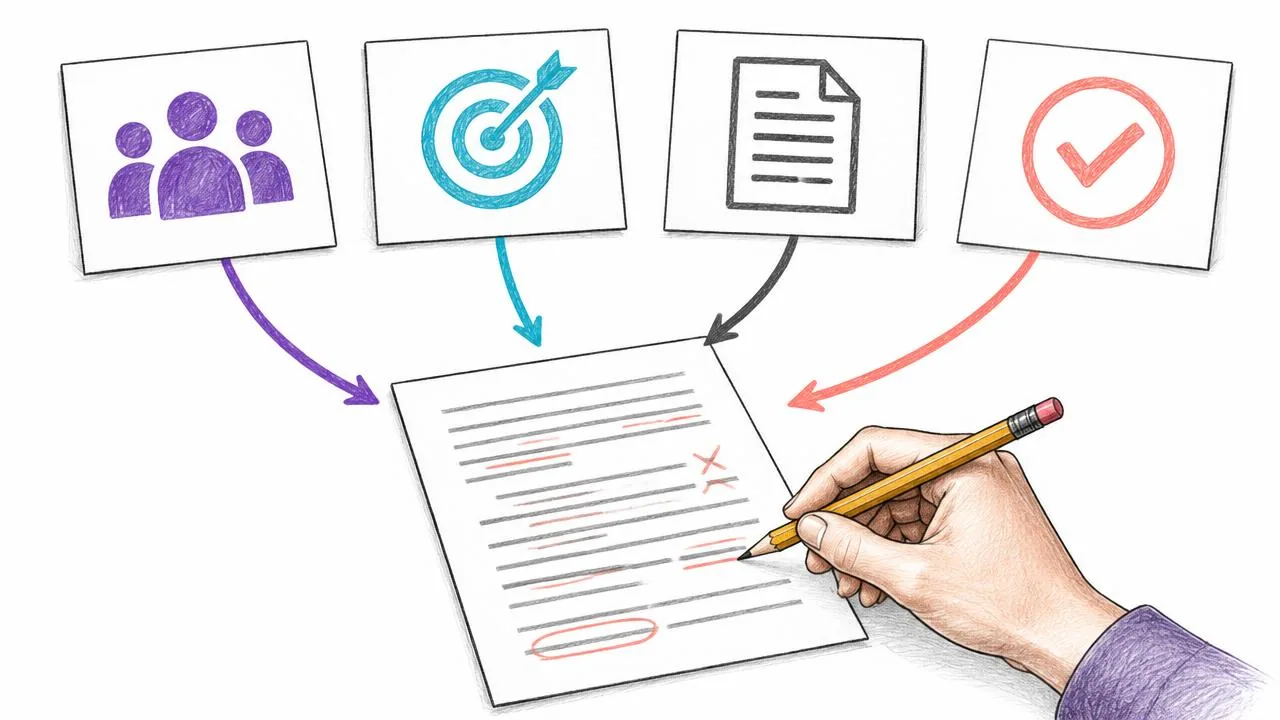
Learning pathway design
- “Break this learning objective down into 5 progressively sequenced activities, each with an observable deliverable.”
- “Suggest three different approaches to teaching [concept] for beginner, intermediate and expert learners.”
- “Using this course outline, list the implicit prerequisites that I should make explicit in the introduction.”
Content production
- “Rewrite this paragraph, keeping its meaning but changing the academic register to practical language for frontline managers.”
- “Generate three concrete examples from different sectors that illustrate [concept].”
- “Turn this list of bullet points into a 90-second voice-over script in a conversational tone.”
Assessment
- “Create 5 quiz questions of increasing difficulty on this content, including 2 comprehension questions and 3 application questions.”
- “Suggest a workplace scenario that draws on the concepts in [chapter 3].”
- “Analyse these learners’ open-ended responses and identify the 3 most common reasoning errors.”
- “Generate an assessment rubric based on this course’s objectives.”
To decide what can be an automated suggestion and what remains a human responsibility, read AI and trainers: planning thoughtful collaboration. Do not submit personal data or confidential materials to a tool without an authorised framework; anonymise examples where possible.
Going further: AI within the learning process
These examples concern training preparation. Tools may also offer interaction with learners during a course; available features depend on the solution and must be checked before you describe them. To explore this topic, see voice interaction in learning and the solution for independent trainers.
Specify the output rather than making a vague request
The ten prompts above benefit from an output specification. Describe the audience in terms of observable prerequisites, the workplace task to be learned, the authorised source material and the expected deliverable. Also specify what the AI must not do: fill in a missing procedure, create a reference or turn a recommendation into a requirement. A short request may be sufficient if these constraints are explicit; piling up contradictory instructions makes validation harder.
Fictional example of an expanded prompt: “Using only the extract below, prepare two scenarios for novice case administrators who need to identify a missing document. For each scenario, provide the instructions, available information, expected answer, its justification and the exact passage supporting it. If the extract does not allow a decision, state insufficient information. Do not add any rules.” The trainer’s deliverable is not the entire conversation, but a reviewed activity sheet accompanied by its documentary reference. Keep the source extract in an authorised location, separate from the learner-facing version.
Test the prompt on a small set of cases
Before reusing a prompt, create three fictional inputs: an ordinary case, an ambiguous case and a case that cannot be resolved using the source material. This last input checks whether the instruction not to invent information is followed. Also repeat the same request: one correct response is not enough to establish reliability. Record the tool’s displayed name and version, the date, the prompt text and the corrections required. This will help you distinguish a change in source material from a change in the assistant’s behaviour.
Use a simple decision rubric: every suggestion must be accurate, traceable, appropriate to the level and usable without hidden information. An error concerning an essential rule means rejection, even if the writing is excellent. Excessive length calls for revision; it never compensates for a substantive error. The deliverable is a table with input, output, identified defect, human correction and decision. This protocol is a local production check, not model certification or a measure of instructional effectiveness.
Check questions before releasing them
For an AI-generated quiz, have a colleague answer each question without showing them the answer key. Ask them to identify the clue that supports the answer and explain why the other options are less appropriate. If two answers can be justified using the materials, rewrite the question or explicitly accept multiple solutions. Remove absurd distractors, nested negatives and details that test tricky reading rather than the target skill. Increasing difficulty should come from the reasoning required, not unnecessarily complicated vocabulary.
Then prepare feedback for each plausible error. In a fictional case-file classification example, confusing a missing document with an expired document calls for two different explanations. The answer key should restate the criterion, show how it applies and suggest a next action. Do not use automated analysis of open-ended responses as the sole basis for high-stakes grading. Start by comparing it with human marking on fictional responses, then examine disagreements before using it with learners.
Maintain a safe, revisable prompt library
The UNESCO guidance published on 7 September 2023 recommends a human-centred approach, with ethical and pedagogical validation of educational uses of generative AI. It does not provide evidence that a particular prompt improves a course. To put this guidance into practice, assign each prompt sheet an owner, an authorised scope, a review date and situations in which the prompt must not be used.
Do not include identifiable learner submissions or confidential exchanges in the library. Replacing a name alone may still leave someone identifiable through their role or circumstances; prefer entirely fictional data for testing. Keep a validated version of the deliverable separate from drafts and record the checks performed. When source material changes, rerun the test inputs before republishing. A useful library therefore contains fewer magic formulas and more tested prompt sheets, complete with limitations and correction histories.
Key takeaways
These ten prompts are starting points to adapt and review. AI can contribute to design and to some learning activities, provided its responses are checked and appropriate instructional oversight is maintained.
Sources and scope
- [enrichment-unesco-2023] Guidance for generative AI in education and researchFengchun Miao and Wayne Holmes, UNESCO, 7 September 2023.
Institutional guidance on governance and educational uses of generative AI, not an effectiveness study. The page indicates an update on 16 January 2026; the guidance itself remains a 2023 publication.
Discover training that responds to your learners’ questions.
Share your objectives and materials with the team to explore how it works and which arrangements need confirming for your project.
Request a demo