
Creating consistent training across a franchise network
A franchise network may want to preserve shared standards while taking local realities into account. In training, distinguishing content that must remain consistent from content that can be adapted is one design approach to validate with the network concerned.
The trap of an imposed one-size-fits-all learning path
A learning path imposed without room for adaptation may be less relevant to some local contexts and harder for people to adopt. These effects are not automatic: collect feedback from franchisees and learners.
A workable model: a common core plus a local layer
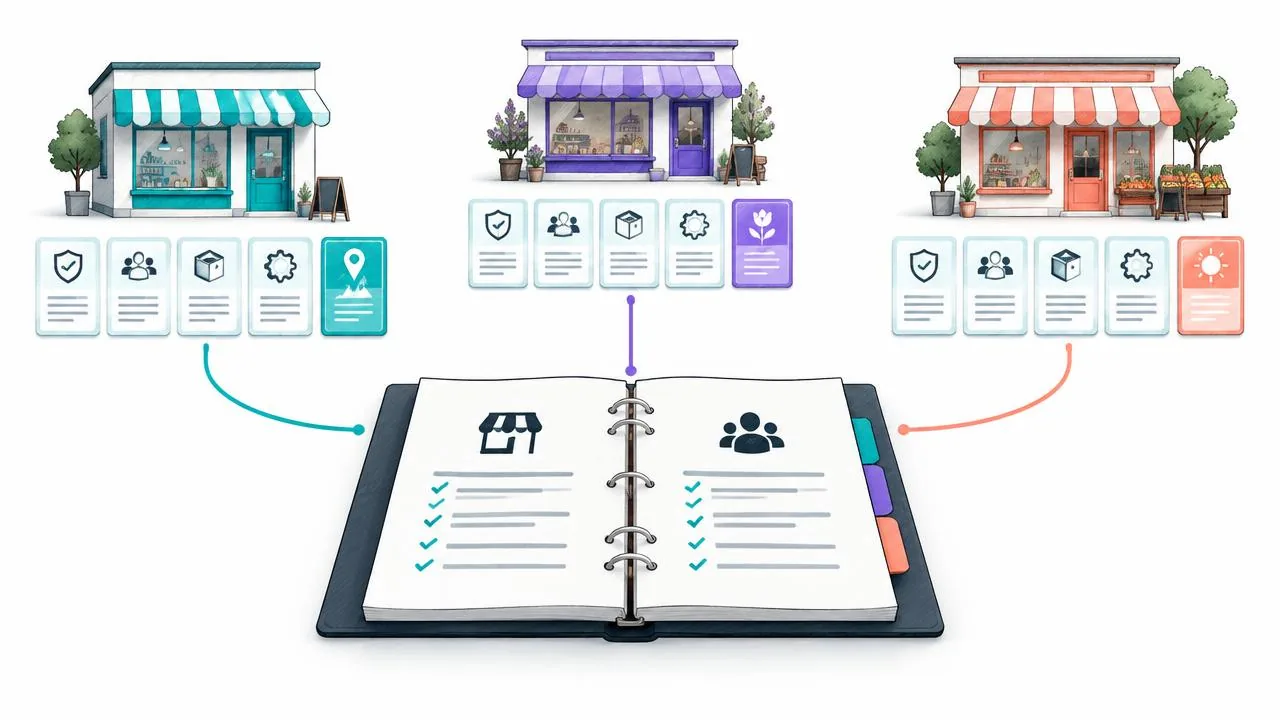
Distinguish a non-negotiable common core—brand, processes, safety and compliance—from a local layer of practical cases, regional product characteristics and examples that each franchisee can enrich.
Depending on the tools available, the programme can distinguish reference content from local resources, with rules for contributions and approval. An AI assistant does not by itself guarantee answers consistent with the core: answers, sources and updating mechanisms must be tested. See the solution for businesses and the evaluation indicators.
Indicators for the franchisor to track
- Common-core completion rate, interpreted in relation to requirements, audiences and tracking arrangements.
- Recurring questions by franchise, examined alongside feedback and activity results.
- Time until an expected workplace task is performed, taking opportunities to practise into account.
- Rate at which other franchises reuse local content.
Define decision-making authority for each type of content
Distinguishing the core from adaptations is not enough when several people can change the same instruction. For each content family, specify who proposes, who checks and who authorises distribution. A subject-matter expert may approve the substance without being responsible for the day-to-day operation of the learning path. Separating these roles prevents a resource being treated as approved merely because it has been reviewed.
A shared instruction still needs to be checked for applicability. Differences in equipment, applicable regulations or organisation may require a specific review rather than unrestricted adaptation. The local contact must be able to flag such differences without independently rewriting a sensitive procedure. Have the network’s appropriate specialists confirm obligations and room for manoeuvre; a learning architecture does not determine them.
The first deliverable is a governance register: content owner, scope of application, approver and change-request process. Add a precedence rule for contradictions between resources. This rule must explain where to find the authoritative reference and whom to contact, rather than asking learners to choose between two apparently official instructions themselves.
Structure local contributions without creating a parallel library
Give sites a short contribution form: the problem encountered, audience concerned, situation illustrated and justification for the adaptation. Ask contributors to distinguish the local example explicitly from the general rule. A working tip observed at one site does not become a network procedure simply because its author thinks it is effective.
Before publication, check consistency with the core and the absence of confidential details or unnecessary identifiable individuals. Then classify the proposal: a local example, a resource reusable after adaptation or a request to change the core. This sorting process recognises practical experience without accumulating near-identical versions. Also specify reuse rights and responsibility for maintaining the example.
The deliverable is a contribution file that is accepted or returned with an explicit reason. For a resource distributed beyond its original site, state the conditions for reuse: associated equipment, commercial context or procedure. Reuse then becomes a documented decision, not simply a popularity indicator. A frequently accessed resource may still be unsuitable for some locations.
Handle changes and check the learning path actually available
A central update does not guarantee that local materials, printouts or welcome messages have changed. Prepare a list of the places where the instruction circulates and assign someone to check each one. When a change affects an activity already completed, decide whether information alone is sufficient or further practice is needed. The level of risk should guide that decision.
Prepare a release pack containing the previous reference, the new version, the nature of the change and the actions expected from sites. An acknowledgement shows that the message arrived, not that the instruction was understood. For an important change, use a checking scenario suited to the task. Do not infer operational compliance from module completion alone.
To test the arrangements, choose sites with genuinely different contexts, rather than only contributors who are already enthusiastic. Record contradictions, access difficulties and requested adaptations. These observations help improve the governance process; they do not by themselves demonstrate improved network results.
Application: a shared procedure for different equipment
The team delivers the reference procedure, a clearly named local appendix and a sheet specifying the sites where it applies. If the example suggests an unapproved technical intervention, it is suspended for review rather than circulated as good practice. This arrangement clarifies the boundary between contextualising learning and changing a rule, without assuming automatic version-management features in a tool.
Key takeaway
Distinguishing common content from local resources can help structure a network learning path, provided you define who approves adaptations and how their quality is monitored. The model must be tested with the franchisees concerned.
Let’s discuss your workplace training project.
Share your objectives and materials with the team to explore how it works and which arrangements need to be confirmed for your project.
Request a demo